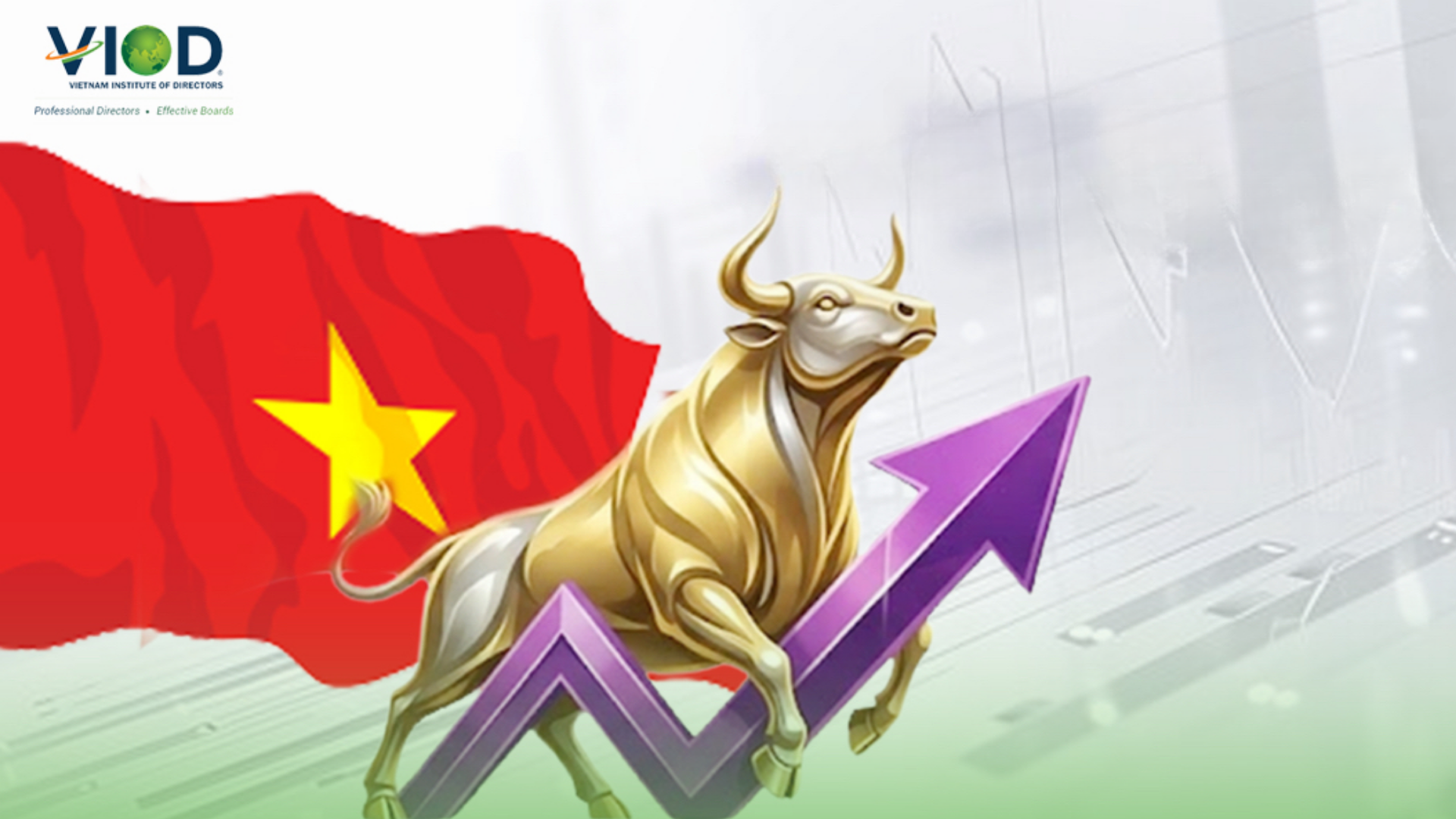
On April 8, 2026, FTSE Russell officially upgraded Vietnam’s stock market from Frontier Market to Secondary Emerging Market status. Vietnamese equities will begin to be included in global indices from September 2026, with full inclusion expected by 2027. The milestone has drawn significant attention, with expectations around capital inflows and market growth running high.
Yet the upgrade is better understood not as a destination, but as a test — a test of whether Vietnam’s market has truly reached the level of quality that its new classification implies. As Mr. Phan Le Thanh Long, CEO of VIOD, observed in a recent interview with Tap chi Kinh te – Tai chinh: the upgrade is “not a magic wand, but a test of the market’s actual quality.” What matters, in other words, is not the title, but what stands behind it.
Capital will follow quality, not the other way around
Expectations around foreign capital inflows are well-founded, but need to be calibrated. Passive flows are scheduled to arrive gradually through the FTSE Global All Cap inclusion roadmap — roughly 10%, 20%, 35%, and 35% across four phases from September 2026 to September 2027, with total passive allocation estimated at around USD 1.53 billion. The more consequential impact, however, lies in what comes next: the active, long-term institutional investors who allocate capital selectively, based on governance standards, transparency, and the quality of oversight.
These investors are not drawn by index membership alone. They look closely at how companies are run, how risks are managed, and how shareholder rights are protected. For Vietnam’s market, the real question is therefore not how much capital the upgrade unlocks in the short term, but whether the market is ready to retain that capital over time.
The Board’s role: from compliance to leadership
This is where the role of the Board of Directors becomes central. In a market newly on the radar of global institutional capital, compliance with disclosure rules is the floor, not the ceiling. Boards are now expected to lead — to elevate governance practices beyond minimum requirements, to strengthen transparency as a matter of institutional posture rather than regulatory obligation, and to engage with international investors through credible, structured investor relations.
This shift redefines what effective board oversight looks like. Risk management must be genuinely integrated into strategic decision-making, not treated as a reporting exercise. Board composition and independence must withstand scrutiny from investors accustomed to global standards. And the quality of board discussions — on strategy, on capital allocation, on ESG — must be substantive enough to support long-term investor confidence.
VIOD’s role in this new phase
For nearly a decade, VIOD has worked alongside Vietnamese boards, senior leaders, and corporate secretaries to strengthen governance practices in line with international standards. As the market enters this new phase, that work takes on sharper relevance. Through the Director Certification Program (DCP), the Corporate Secretary Master Program (CSMP), and the Audit Committee Master Program (ACMP), along with targeted workshops and peer exchanges, VIOD continues to accompany directors and executives in building the practical capabilities that the post-upgrade market will demand — from board effectiveness and risk oversight to investor engagement at global standards.
This is not about training for a one-time milestone. It is about embedding governance quality as a defining feature of how Vietnamese companies operate — so that the market’s upgraded classification is matched, and eventually exceeded, by the substance behind it.
A new chapter, measured in substance
The FTSE Russell upgrade marks a new chapter for Vietnam’s capital market — one that will be defined less by capital flows in the immediate term and more by the discipline, transparency, and governance culture that take root in the years ahead. Upgrading the market, in the end, is inseparable from upgrading the mindset of everyone who participates in it: regulators, companies, boards, and investors alike.
Vietnam has earned its new classification. The work now is to live up to it.
Further reading: “Nâng hạng thị trường: Không nằm ở ‘danh xưng’, mà ở chất lượng thực của thị trường” — interview with Mr. Phan Le Thanh Long, CEO of VIOD, Tap chi Kinh te – Tai chinh, 8 April 2026.