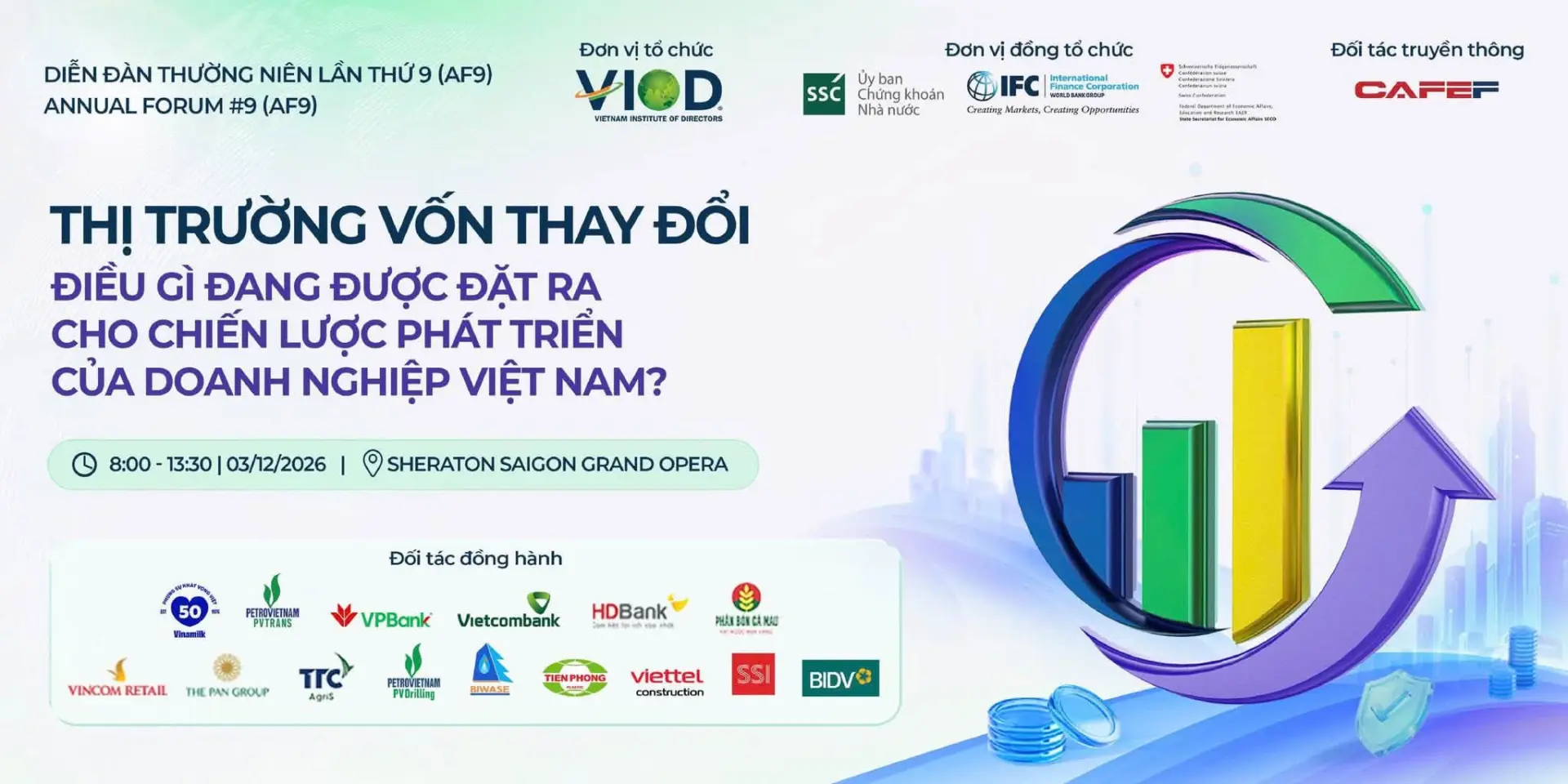
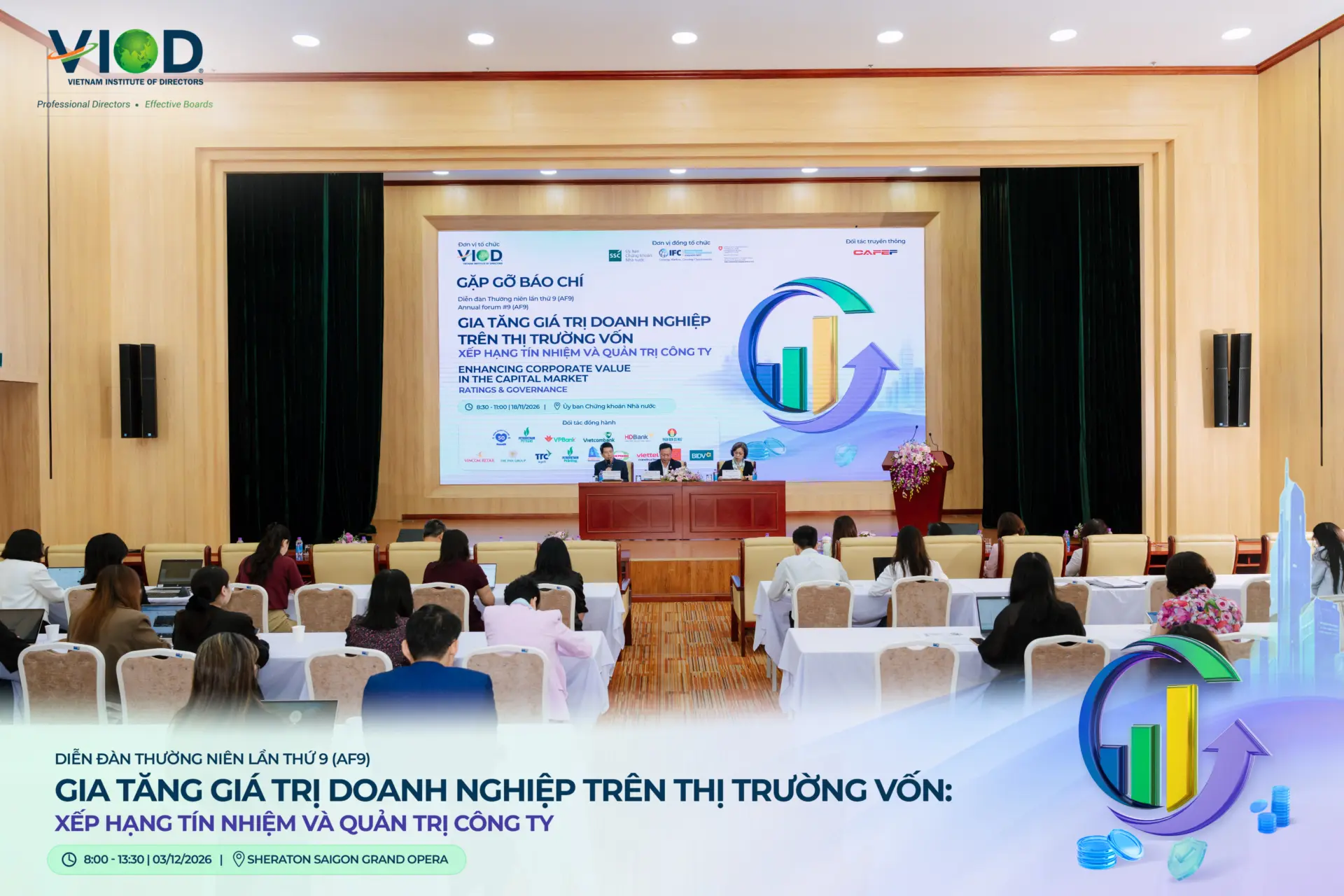
“To raise long-term capital, businesses must build long-term trust.” This was the core message emphasized by Ms. Ha Thu Thanh, Chairperson of the Vietnam Institute of Directors (VIOD), at the Press Briefing on November 18 ahead of the 9th Annual Forum (AF9). Beyond the narrative of capital raising lies a broader imperative for Vietnamese enterprises: On what grounds can the market trust a company’s ability to create value not just today, but over the next 3, 5, or 10 years?
On November 18, 2026, at the headquarters of the State Securities Commission (SSC), VIOD, alongside representatives from the SSC and the International Finance Corporation (IFC), hosted a Press Briefing to introduce the 9th Annual Forum themed “Enhancing Corporate Value in Capital Markets: Credit Ratings and Corporate Governance.” The event went beyond merely providing information about AF9; it opened a dialogue on the prerequisites businesses must prepare, as the demand for medium- and long-term capital becomes increasingly tied to creditworthiness, transparency, and Corporate Governance capabilities.
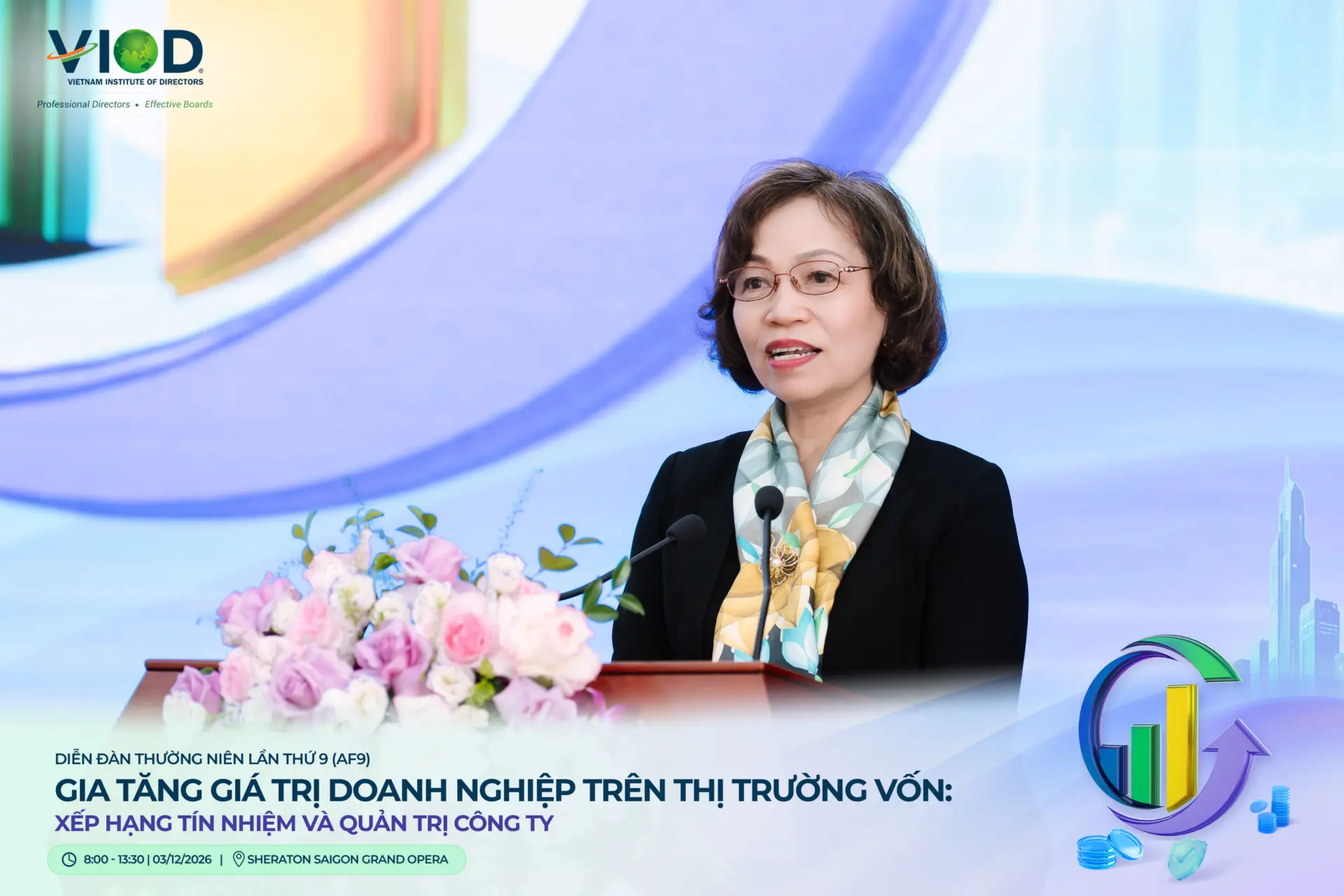
Ms. Ha Thu Thanh, Chairperson of the Vietnam Institute of Directors (VIOD), speaking at the Media Briefing.
Long-term capital poses a long-term question of trust
As businesses enter a new investment cycle, capital needs are no longer measured solely by scale. A multi-year development plan requires funding with suitable maturities, controllable costs, and the capacity to accompany the corporate strategy over the long haul.
In this context, stock and bond markets increasingly need to assert their roles alongside bank credit channels to meet medium- and long-term capital demands. However, accessing these funding sources depends not only on how much a company wishes to raise or its most recent profit results. It also depends on the extent to which the market can assess risks, cash flow generation capacity, and the company’s ability to fulfill future commitments.
This was the focal point emphasized by Ms. Ha Thu Thanh at the briefing. Financial statements provide vital data on past performance, but for a long-term investor, the inquiry does not stop at what a business has achieved. What they need to understand is how value will be created in the coming years, how capital will be utilized, what risks might impact the strategy, and whether the company is capable of delivering on its commitments.
Therefore, long-term trust cannot be built solely at the moment a company needs capital. It is the result of a cumulative process, reflected in governance quality, transparency, and the ability to maintain accountability across multiple business cycles. This is the overarching message posed by AF9: How can Vietnamese enterprises raise more capital, earn market trust, secure better valuations, and achieve more sustainable growth?
Credit Ratings and Corporate Governance: Keys to unlocking long-term capital and enhancing corporate value
A notable point in how AF9 approaches the capital equation is that it does not treat Credit Ratings and Corporate Governance as two separate topics.
Credit ratings provide an independent assessment for investors and capital providers to evaluate a company’s ability to meet financial obligations and its risk profile. Corporate Governance (CG), on another layer, reveals how a company’s decision-making system, accountability, risk management, and sustainable development capabilities are structured. AF9 places these two elements in direct correlation with the ability to access capital and enhance corporate value.
While good Corporate Governance is not a guarantee of an immediate credit rating upgrade or a lower cost of capital, it establishes the foundation for a business to demonstrate its substantive capacity. Substantive capacity here refers to how strategy is formulated and overseen, how material risks are managed, what mechanisms protect the rights of shareholders and stakeholders, and whether information is transparent enough for market scrutiny.
Therefore, instead of viewing CG as a requirement to fulfill only after a business has grown, the message at the briefing reverses the perspective: Corporate governance is an investment in the company’s own competitiveness and long-term value.
Governance quality is becoming a basis for the market to differentiate businesses
This becomes even more prominent as Vietnamese enterprises enter a capital market with a higher degree of integration and comparability.
The ASEAN Corporate Governance Scorecard (ACGS), an initiative of the ASEAN Capital Markets Forum (ACMF), was launched in 2011 with the goal of raising CG standards and practices among ASEAN listed companies, while enhancing the visibility of well-governed enterprises to the international investment community. The ACGS was updated in 2023 to reflect the new G20/OECD Principles of Corporate Governance, incorporating elements on shareholder rights, transparency and disclosure, Board responsibilities, sustainability, and resilience.
From Vietnam’s perspective, the gap in practice quality remains quite evident. Results shared by VIOD at the press briefing showed that among the 100 assessed companies, the top 20 achieved an average ACGS score of 81.1 points, outperforming the ASEAN average of 65 points; meanwhile, the remaining 80 companies averaged 56.4 points.
These figures present two sides of the same coin. A group of Vietnamese businesses has proven capable of advancing to higher practice standards and competing in governance quality regionally. However, the gap between the top tier and the rest also indicates that the upgrading of standards is not occurring evenly.
The number of companies included in the assessment scope increased from 69 to 100, with approximately 34% scoring above average. This signals a broader evaluation scope, while simultaneously setting clearer demands on the market’s pace of improvement.
ACGS20 and VNCG50: From “standards” to a reference framework for businesses and investors
Given this context, this year’s AF9 dedicates a significant segment to two initiatives: ACGS20 and VNCG50.
ACGS20 recognizes the top 20 Vietnamese companies in the ASEAN Corporate Governance Scorecard assessment, aiming to elevate the position of Vietnamese businesses regionally, and broader still, establishing recognition standards for companies with outstanding governance quality in ASEAN. Meanwhile, VNCG50 was developed by VIOD as an annual CG practice assessment criteria set for Vietnamese listed companies, designed to assist businesses in improving practices, narrowing the regional gap, and gradually laying the groundwork for a VNCG50 index.
The VNCG50 selection process is designed as a step-by-step screening. From the 100 companies evaluated against the VNCG50 criteria, 70 qualifying companies are shortlisted; from there, 50 are selected based on assessment results and reviews by the Evaluation Council. This approach ensures that VNCG50 goes beyond merely acknowledging companies with good practices; it creates a reference framework for businesses to reflect on their own governance gaps and provides the market with additional grounds to differentiate CG quality among listed companies.
The two initiatives aim to provide businesses with a reference point to examine the gap between current practices and best practices. For investors, this adds a layer of information to consider governance quality alongside financial data. For the market, as more businesses proactively benchmark themselves against comparable criteria, it helps shift the CG narrative from “sufficient for compliance” to “sufficient quality to earn market valuation.”
The Board of Directors is where trust translates into practice
A set of criteria or a score only holds meaning when the underlying principles are translated into actual corporate decisions. That is why AF9’s ultimate question circles back to the Board of Directors (BOD).
In this new era, the BOD cannot stop at merely meeting compliance requirements; they must proactively direct capital strategy, elevate CG quality, and build the company’s creditworthiness.
At a practical level, this raises highly specific questions: Does the capital strategy align with the company’s long-term investment needs? How will corporate value be sustained over the next 3, 5, or 10 years? What risks could impact that process? And who is responsible for overseeing and protecting the interests of shareholders and stakeholders?
From the perspective of capital providers, addressing these issues helps the market assess whether a company possesses a clear strategy, financial discipline, oversight mechanisms, and robust execution capabilities to manage capital in the long term.
AF9 continues the dialogue from “why” to “what must the BOD do?”
The Press Briefing on November 18 laid out a thematic thread that AF9 will explore in greater depth: from the economic outlook and capital needs, to how the market assesses corporate creditworthiness, elevating CG practices, and ultimately, the actions of the BOD.
The AF9 program on December 3 will continue this thread with presentations on the macroeconomic landscape of Vietnam for 2026-2028 and its impact on capital markets by Mr. Michael Kokalari, Chief Economist at VinaCapital; Corporate Credit Ratings and opportunities to increase medium-term capital by Mr. Nguyen Quang Thuan, FiinGroup & FiinRatings; Perspectives on the role of professional CG institutions by Ms. Jackie Mah, CEO of the Institute of Corporate Directors Malaysia; alongside the central panel discussion answering the question, “What must the Board of Directors do?”.
AF9 will also honor the 2026 ACGS20 and VNCG50, not merely to recognize pioneering businesses, but to establish additional reference points for the corporate community to reflect on its own journey of elevating governance standards.
As the capital market becomes more professional and highly comparable, trust will increasingly rely less on a single message or a single year’s business results. Instead, it will be accumulated through the quality of decision-making, transparency levels, risk management capabilities, and the consistency between a company’s commitments and its actual actions.
| The 9th Annual Forum (AF9 2026), organized by the Vietnam Institute of Directors (VIOD) under the theme “Enhancing Corporate Value in Capital Markets: Credit Ratings and Corporate Governance,” serves as a strategic dialogue platform to analyze the corporate governance landscape and the role of credit ratings in unlocking long-term capital. The event is expected to bring together approximately 350 top executives to discuss solutions for reinforcing market trust and elevating the core competitiveness of businesses. Time: 08:00 – 13:30 | Thursday, December 3, 2026 Venue: Sheraton Saigon Grand Opera Hotel, Ho Chi Minh City Information and Registration: https://crm.viod.vn/annual-forum-9 |