Vietnam’s capital market is entering a new phase, where market-based funding channels are expected to play a more prominent role in meeting the investment and growth needs of the corporate sector. For Boards of Directors and Executive Management, the challenge therefore lies not only in the volume of capital raised, but also in selecting funding sources with the right maturity, cost, and risk profile to match their development strategies. Simultaneously, they must build sufficient capabilities to secure the market’s long-term evaluation and trust.
Following a positive 2025, the stock market’s upward momentum has been sustained in 2026, while the corporate bond market is gradually regaining its role as a medium- and long-term capital channel. However, the World Bank assesses that the scale of Vietnam’s capital market remains relatively limited compared to the resource mobilization needs for growth. Outstanding corporate bond debt is currently equivalent to around 10% of GDP, against a target of at least 25%; meanwhile, the stock market capitalization is also targeted to increase from 78% of GDP in 2025 to 120% by 2028.
Alongside its scale expansion, the standing of Vietnam’s market is also shifting. Starting September 21, 2026, Vietnam embarks on a roadmap to join the FTSE Russell emerging market group, with four implementation phases extending to September 2027. The World Bank estimates this upgrade could generate an additional $3-5 billion in portfolio inflows during the initial years, simultaneously broadening access to international institutional investors.
Yet, for individual businesses, a larger market and access to more funding sources do not automatically translate to easier capital raising. As investors gain more options and sophisticated tools for risk assessment, the question shifts from “where can a company raise capital?” to “what capabilities must a company build to access funding that aligns with its development strategy?”. This is the juncture where capital strategy, creditworthiness, and Corporate Governance quality must be viewed as parts of the same equation.
Long-term growth demands a long-term capital strategy
To execute a 3, 5, or 10-year development plan, it is not enough for a business to merely determine the volume of capital required. Equally crucial is the source of that funding, whether its maturity aligns with the investment lifecycle, and if the cost of capital corresponds to the company’s cash flow generation capacity.
Bank loans, bonds, equity, or retained earnings carry distinct characteristics regarding maturity, cost, financial obligations, and risk-sharing levels. Therefore, choosing a capital structure is not an isolated financial decision but is directly linked to the company’s growth model, risk appetite, and value creation capability.
This explains why deepening the capital market is significant for the corporate sector. The G20/OECD Principles of Corporate Governance 2023 emphasize that stock and bond markets help businesses diversify funding sources while enhancing their resilience during challenging periods.
From the Board of Directors’ (BOD) perspective, the question of capital must therefore be raised early in the strategic planning process. How far does the company want to grow, what leverage ratio should be maintained, what resources must be allocated for reinvestment, and what is the optimal capital structure to simultaneously execute the development plan and maintain financial buffers across different market cycles?
As funding diversifies, creditworthiness becomes integral to capital access strategies
Within that capital structure, corporate bonds play a notable role as a medium- and long-term mobilization channel. FiinRatings observes that the Vietnamese corporate bond market will continue to consolidate this role in 2026, but market access will increasingly diverge based on the credit quality and transparency of issuers. Companies with high leverage, weak cash flows, or limited disclosure may face greater difficulties in reaching investors.
This highlights the role of credit ratings. In a market with multiple issuers carrying varying risk levels, investors require a baseline to assess the ability to meet financial obligations and to compare credit risks among enterprises. At the Vietnam Corporate Bond Market Forum 2026, FiinRatings also identified the difficulty in assessing credit risk as one of the market’s major bottlenecks, thereby emphasizing the need for a robust credit rating framework to standardize risk evaluation.
However, a credit rating is not merely a result generated at the moment a company prepares for a bond issuance. Repayment capacity, financial structure, cash flow, asset quality, and business stability are all shaped by prior decisions. Therefore, enhancing creditworthiness is essentially an internal preparation process, intrinsically linked to how a business plans its growth and utilizes long-term capital.
Corporate Governance directly impacts access to capital
Financial quality, however, is only one aspect of how the market evaluates a business.
According to the G20/OECD Principles of Corporate Governance, a well-designed Corporate Governance framework can support businesses in accessing finance, particularly from capital markets. For capital providers, good Corporate Governance provides further assurance that they can participate in the company’s value creation process under fair and transparent conditions; thus, governance quality can influence the cost a business must pay to access growth capital.
Here, the nexus between capital strategy and the BOD’s role becomes clearer. A growth plan may require additional capital, but investors also need to understand how that capital will be allocated, what risks are overseen by the BOD, how shareholder rights are protected, and whether the company is transparent enough for the market to track strategic execution. Consequently, the ability to access capital stems not just from the balance sheet, but from the quality of the governance system behind financial decisions.
This represents a progressive step in the discussion thread that VIOD initiated at its 8th Annual Forum (AF8). AF8 focused on guiding BODs beyond a compliance mindset to build trust and reputation in the capital market through strategic leadership, risk management, and consistent, transparent accountability.
At AF9, the question delves deeper into the capacity to translate these foundations into creditworthiness, capital access, and corporate value in the capital markets.
Three perspectives for a strategic equation
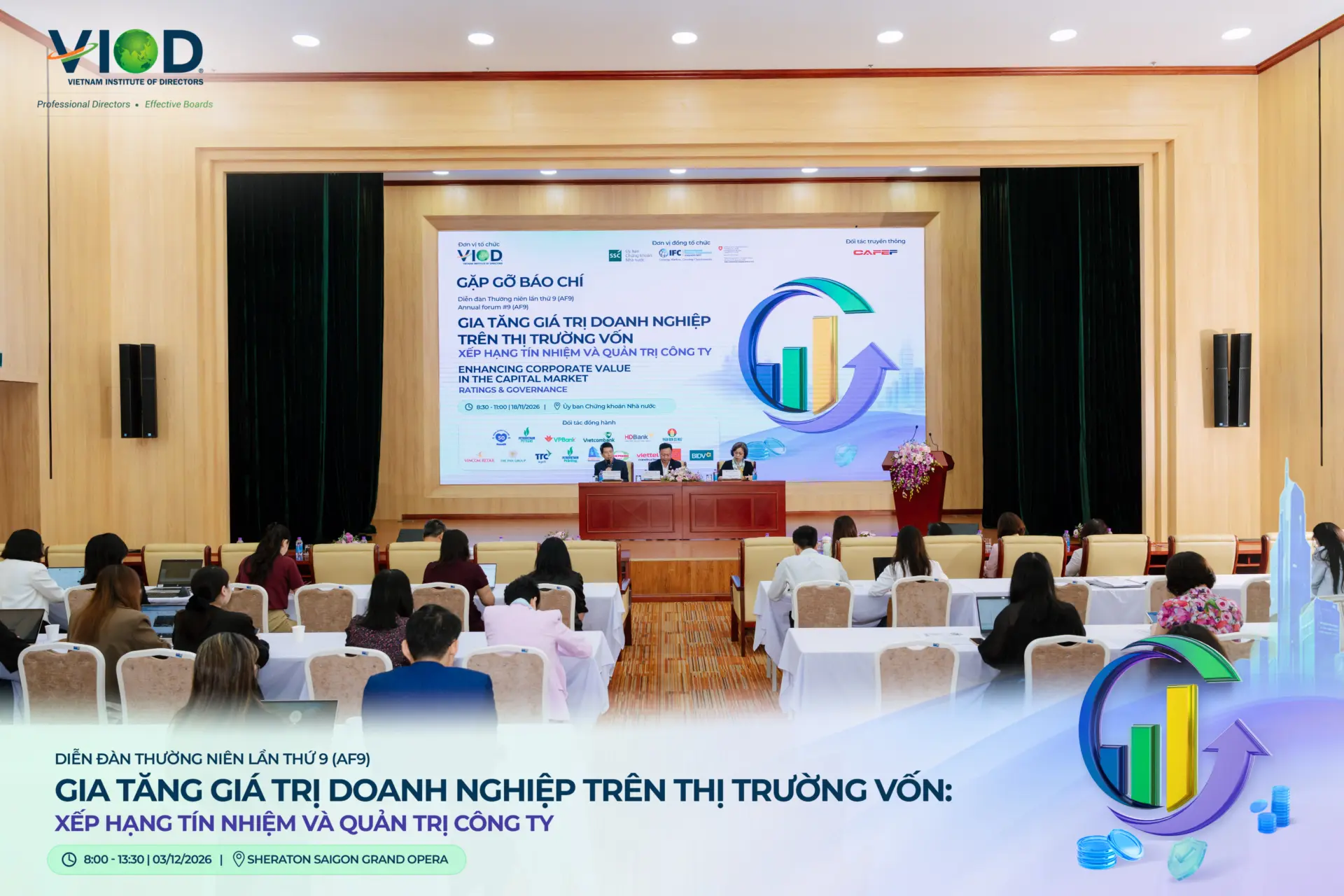
Against this backdrop, the 9th Annual Forum (AF9), themed “Enhancing Corporate Value in Capital Markets: Credit Ratings and Corporate Governance,” is designed to place credit ratings and Corporate Governance quality within the same equation of corporate value. Following its program orientation, AF9 aims to connect corporate BODs with regulators, financial institutions, rating agencies, and institutional investors to expand the dialogue on the necessary conditions for businesses to access capital markets.
The forum approaches the issue from three directly interrelated perspectives. The economic outlook provides the context for businesses to set assumptions for their growth strategies. According to the World Bank’s October 2026 update, Vietnam’s GDP growth is forecast to reach 7.4% in 2026 and 7.3% in both 2027 and 2028, outpacing the projected average for the East Asia and Pacific region. However, this outlook is accompanied by uncertainties in the global economic and trade environment, demanding that businesses balance growth objectives with resilience against volatility.
Credit ratings distill the narrative from the broad economic outlook down to the capital access capabilities of individual businesses.
The Board of Directors and capital strategy serve as the connecting layer between these two aspects and corporate execution capabilities. As the economic environment evolves and the market acquires more tools to evaluate issuer quality, the BOD must view capital strategy not merely through the lens of how much can be raised, but how that funding is utilized to create value, how risks are controlled, and the extent to which the business can sustain the trust of capital providers over the long term.
For the BOD and Executive Management, the shifting capital market thus poses a question broader than merely seeking finance for the next plan: what capabilities must the business build today so that its growth strategy for the next 3-5 years rests on an appropriate capital foundation, capable of accessing the market and driving long-term value creation?
This is exactly the issue AF9 aims to address, fostering a broader dialogue among businesses, investors, rating agencies, and capital market participants.
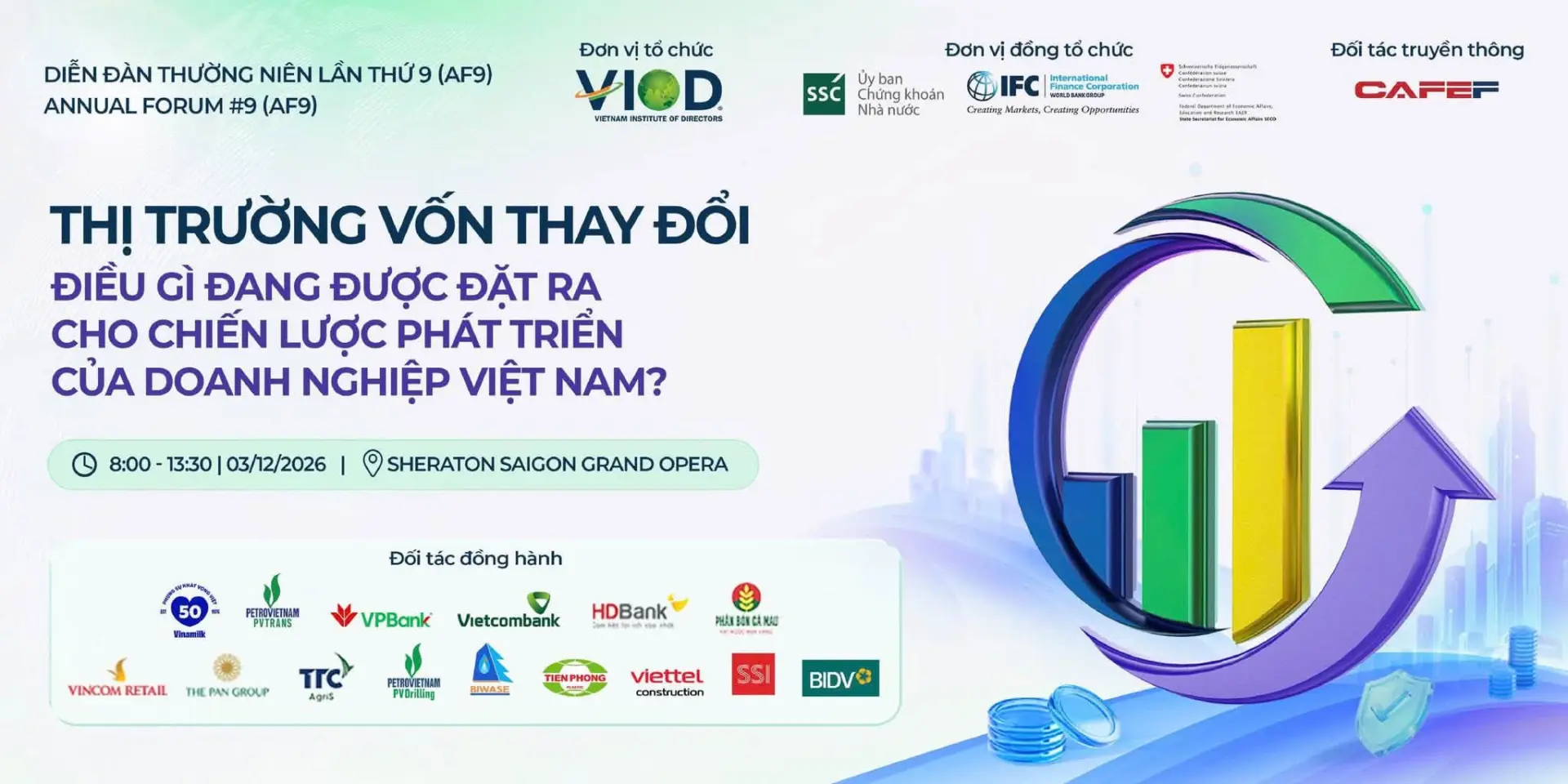
| The 9th Annual Forum (AF9 2026), organized by the Vietnam Institute of Directors (VIOD) under the theme “Enhancing Corporate Value in Capital Markets: Credit Ratings and Corporate Governance,” serves as a strategic dialogue platform to analyze the corporate governance landscape and the role of credit ratings in unlocking long-term capital. The event is expected to bring together approximately 350 top executives to discuss solutions for reinforcing market trust and elevating the core competitiveness of businesses. Time: 08:00 – 13:30 | Thursday, December 3, 2026 Venue: Sheraton Saigon Grand Opera Hotel, Ho Chi Minh City Information and Registration: https://crm.viod.vn/annual-forum-9 |